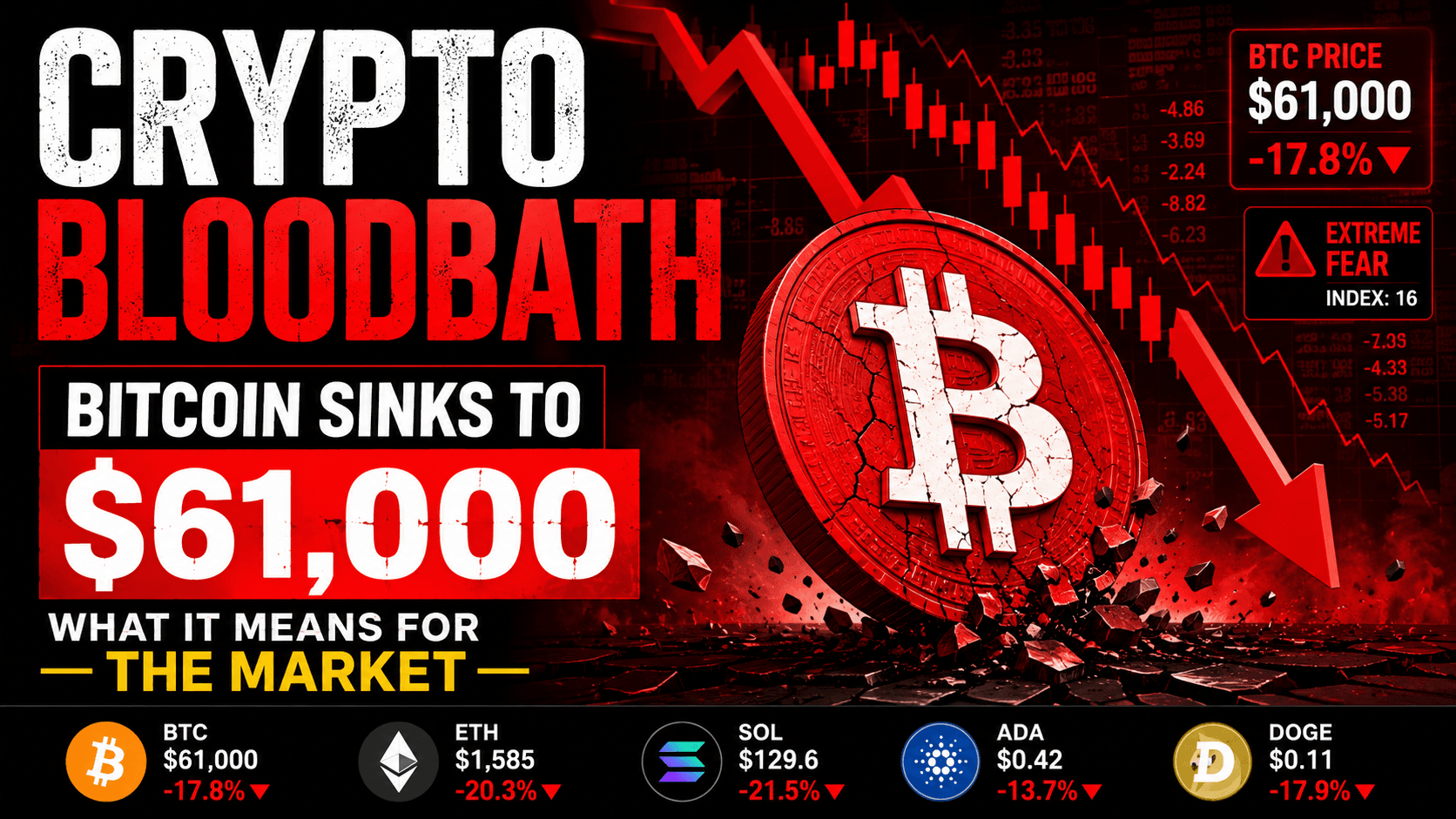

2026 Crypto Downturn is reshaping the digital asset industry as investors face regulatory uncertainty, geopolitical tensions, and changing market conditions.
2026 Crypto Downturn and Geopolitical Drivers
While retail sentiment has shifted toward caution, the underlying infrastructure of the digital asset ecosystem continues to mature. This comprehensive market analysis covers current price actions, regulatory battles in the United States Senate, the evolution of stablecoins, and the emerging trends shaping the rest of 2026.
1. Market Overview: June 2026 Price Action
The digital asset sector faces heightened volatility. Long-term liquidations have surpassed $1.1 billion over a 48-hour window, triggered by cascading macroeconomic shifts.
Bitcoin (BTC) Struggles Beneath Psychological Support
Bitcoin has dropped to $63,731, down substantially from its brief consolidation above $70,000 earlier this year. Long-term holders are accelerating distribution, and capital has rotating heavily into traditional tech equities and artificial intelligence infrastructure.
The technical outlook reveals a market under stress. The 14-day Relative Strength Index (RSI) is hovering near 37 on weekly timeframes. Analysts indicate that if BTC fails to defend the immediate $60,000 to $61,000 support zone, a structural correction could open the path toward the mid-$40,000 range before establishing a cyclical bottom.
Ethereum (ETH) and Altcoins Experience Outflows
Ethereum has underperformed the broader market, dropping to $1,740. Standard Chartered recently adjusted its 2026 ETH price target downward by 47% to $4,000, reflecting slow institutional inflows into Ethereum spot products and a shrinking decentralized finance (DeFi) market share, which now sits at roughly 9.7%.
Major Layer-1 assets are seeing similar pullbacks. Solana (SOL) lost its $70 psychological baseline, while Binance Coin (BNB) briefly dipped under $600. A notable exception to the bearish trend is Stellar (XLM), which rallied over 40% to $0.2862 following news that Wall Street’s central clearinghouse, the DTCC, plans to connect its tokenized securities platform to the Stellar network.
2. Macroeconomic and Geopolitical Drivers
The primary catalyst for the mid-year crypto downturn is a confluence of international conflicts and macroeconomic policy changes.
The U.S.-Iran Conflict:
Ongoing friction in the Middle East has disrupted global supply chains and kept financial markets on edge. Rather than acting as a safe-haven asset, Bitcoin has behaved like a risk-on asset, shedding the premium it gained during initial escalations.
Bond Yields and Fed Policy:
The yield on the 30-year U.S. Treasury bond broke past 5.19%, its highest level since the 2008 financial crisis. Stubborn inflation driven by energy costs has forced the Federal Reserve to delay projected interest rate cuts. High yields on risk-free government debt have drained liquidity away from speculative assets, leading to consecutive net outflows of over $2.8 billion from spot Bitcoin ETFs.
3. Regulatory Showdowns in Washington
Regulatory clarity is taking center stage in the United States, with two major legislative and administrative battles unfolding in Washington.
H.R. 3633: Clarity Act → Passed Senate Banking Committee (15-9) → Placed on Senate Calendar
Key Issues:
- SEC vs CFTC Jurisdictions
- Stablecoin Yields
- DeFi Compliance Rules
- Ethics and Conflict Provisions
The Digital Asset Market Clarity Act (H.R. 3633)
On June 1, 2026, the Digital Asset Market Clarity Act (H.R. 3633) was officially reported to the Senate and placed on the legislative calendar. Championed by Senator Tim Scott, the bill cleared the Senate Banking Committee in a bipartisan 15-9 vote.
The bill seeks to establish a unified market framework, but final passage requires reconciliation with the Senate Agriculture Committee’s parallel bill, the Digital Commodity Intermediaries Act (S. 3755).
Several key sticking points remain:
- Jurisdictional Boundaries: The precise division of regulatory power between the SEC and the CFTC.
- DeFi Obligations: The extent to which decentralized protocols must comply with traditional intermediary rules.
- Ethics Provisions: Conflict-of-interest regulations governing digital asset holdings by federal officials.
The 401(k) Crypto Battle
Simultaneously, a sharp divide has emerged over retirement assets. High-profile Congressional Democrats, including Senators Bernie Sanders and Elizabeth Warren, issued a 14-page letter to the Department of Labor. The letter demands the immediate withdrawal of a rule implemented under Executive Order 14330, which creates a safe harbor for 401(k) plan fiduciaries to offer cryptocurrency investments.
4. The Institutionalization of Stablecoins
While speculative trading volumes drop, stablecoins are cementing their position as essential infrastructure for commercial payments and banking integration.
SoFi Bank Launches SoFiUSD
Marking a milestone in traditional banking integration, SoFi Technologies announced the debut of SoFiUSD, the first stablecoin issued directly by a U.S. national bank on a public banking platform.
Global Trends: MiCA and Reserve Guardrails
This shift aligns with broader global trends identified in the PwC Global Crypto Regulation Report 2026. Policymakers have moved away from blanket bans, focusing instead on reserve transparency, mandatory redemption rights, and operational controls.
5. Emerging Trends and Structural Shifts
Real-World Asset (RWA) Tokenization
Financial institutions are actively linking tokenized assets such as corporate bonds, real estate, and trade instruments to national settlement networks.
Zero-Knowledge Proofs (ZKPs) for Compliance
ZKPs allow market participants to verify regulatory requirements without exposing sensitive underlying data.
AI Integration in DeFi
Artificial intelligence agents are moving into core decentralized workflows. Advanced AI tools are being deployed to automate portfolio management, optimize liquidity aggregation, and run real-time risk assessments.
6. Regulatory Landscape and 2026 Tax Compliance
The Launch of Form 1099-DA
The biggest adjustment for digital asset investors is the introduction of Form 1099-DA. Distributed by digital asset brokers, this form reports gross transaction proceeds directly to tax agencies.
Distinct Taxable Actions
| Action | Tax Treatment |
|---|---|
| Fiat Purchase | Non-Taxable Event |
| Wallet-to-Wallet Transfer | Non-Taxable Event |
| Token Swaps (BTC to ETH) | Taxable Capital Gain/Loss |
| Stablecoin Conversions | Taxable Capital Gain/Loss |
| Staking and Mining Rewards | Ordinary Income |
| Commercial Purchases | Taxable Capital Gain/Loss |
Conclusion: A Market in Maturation
The mid-2026 cryptocurrency market correction reflects an industry shedding speculative excess to integrate with the global financial core. While macro pressures and strict regulatory frameworks have dampened short-term price action, they are establishing the foundation for sustained corporate and institutional adoption.
The survival of individual protocols now relies on clear economic utility, verifiable security compliance, and structural resilience.
The 2026 Crypto Downturn may ultimately strengthen the long-term foundation of the cryptocurrency industry.Bitcoin Price Analysis 2026https://www.coingecko.com/en/coins/bitcoin
2026 Crypto Downturnhttps://khaldir.com/2026/05/24/bitcoin-market-boom-2026-smart-investors/
The 2026 Crypto Downturn may ultimately strengthen the long-term foundation of the cryptocurrency industry.The 2026 Crypto Downturn may ultimately strengthen the long-term foundation of the cryptocurrency industry.