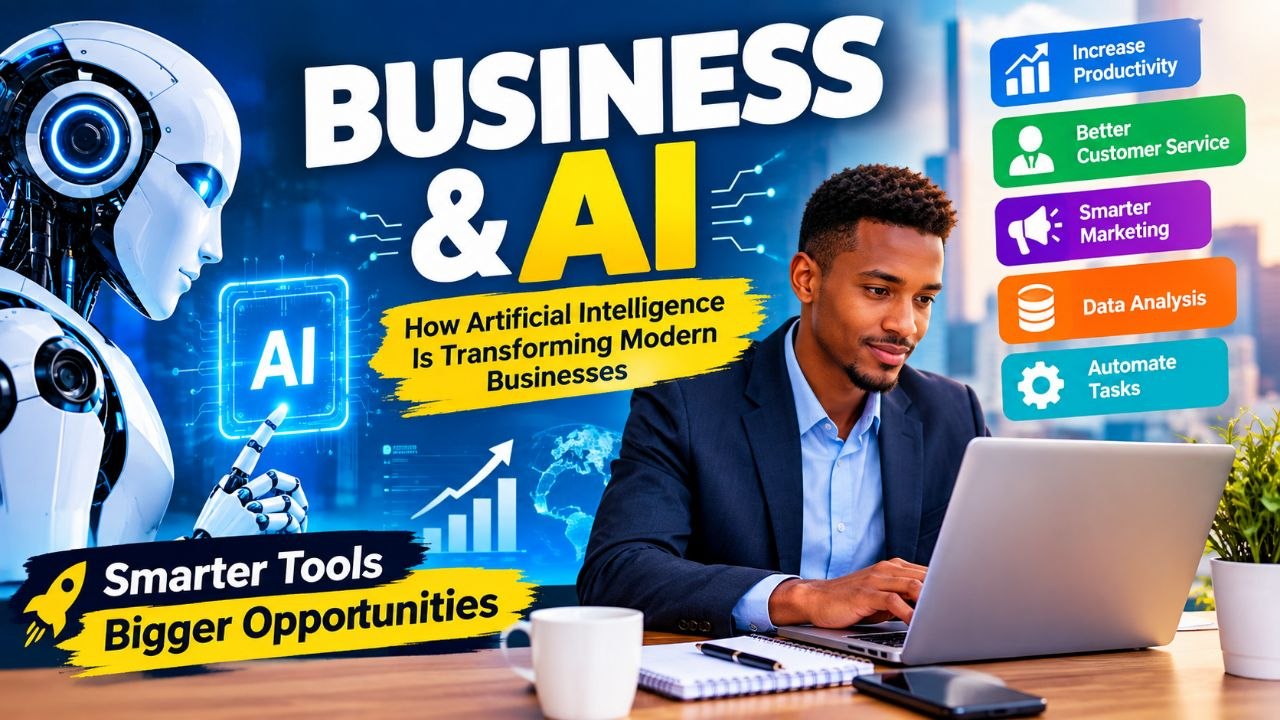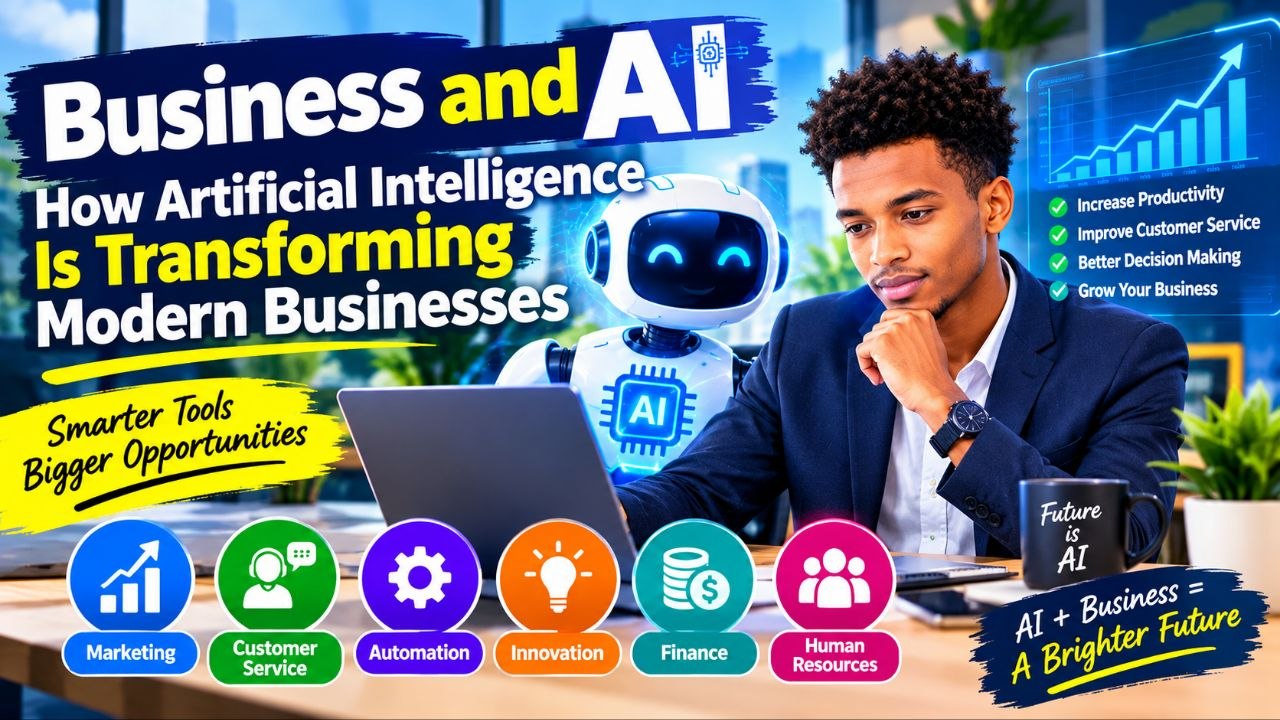
Business and AI: How Artificial Intelligence Is Transforming Modern Businesses
Artificial intelligence, commonly known as AI, is becoming one of the most important technologies in the modern business world. Companies of different sizes are using AI-powered tools to improve productivity, understand customers, analyze information, automate repetitive tasks, and make better decisions.
In the past, many advanced technologies were mainly available to large corporations with significant budgets. Today, businesses of all sizes can access a wide range of AI tools through websites, applications, cloud platforms, and software services. This has created new opportunities for small businesses, entrepreneurs, freelancers, and organizations.
However, successful use of AI requires more than simply adopting new technology. Businesses need to understand how AI works, where it can provide value, and what risks should be considered.
What Is Artificial Intelligence in Business?
Artificial intelligence refers to computer systems that can perform tasks that normally require certain forms of human intelligence. These tasks can include analyzing information, recognizing patterns, understanding language, generating content, and making predictions based on data.
In business, AI can be used as a support tool rather than simply as a replacement for human workers. For example, a company may use AI to organize information while employees review the results and make final decisions.
AI applications can be found in customer service, marketing, sales, finance, human resources, software development, logistics, and many other areas.
AI Can Improve Business Productivity
One of the biggest benefits of AI is its ability to assist with repetitive tasks. Employees often spend considerable time performing activities such as organizing documents, summarizing information, answering common questions, preparing reports, or managing large amounts of data.
AI-powered software can help automate parts of these processes. This can give employees more time to focus on tasks that require creativity, communication, problem-solving, and professional judgment.
For example, a business may use an AI assistant to create a first draft of a report. An employee can then review the document, correct errors, add important information, and prepare the final version.
This approach can improve efficiency while keeping human oversight involved.
AI and Customer Service
Customer service is another area where AI is becoming increasingly useful. Businesses can use AI-powered chat systems to answer common questions, provide basic information, and guide customers toward appropriate resources.
For example, an online store may use an AI assistant to help customers understand shipping information, product categories, or return procedures.
AI can also help businesses analyze customer questions and identify common problems. If many customers repeatedly ask about the same issue, the business can improve its website or support materials.
However, AI customer service should have appropriate human support available. Complex complaints, sensitive issues, and situations requiring professional judgment may need to be handled by a human representative.
AI in Marketing
Marketing has changed significantly because of digital technology, and AI is adding another layer of tools for businesses.
AI can help marketers analyze audience information, organize campaigns, generate ideas, and identify patterns in customer behavior. It can also assist with creating drafts for advertisements, social media posts, email campaigns, and other marketing materials.
However, businesses should not publish AI-generated content without reviewing it. Marketing materials need to be accurate, relevant, and appropriate for the target audience.
Human creativity remains important because successful marketing depends on understanding customers and communicating ideas effectively.
AI and Small Businesses
Small businesses can benefit from AI because many tools are now available through affordable online services. A small company may use AI to help organize customer inquiries, analyze business data, prepare content, or automate simple administrative tasks.
For entrepreneurs who work alone, AI can act as an additional productivity tool. It may help with brainstorming, research organization, writing drafts, and planning.
Nevertheless, small businesses should choose tools carefully. They should consider cost, security, reliability, data policies, and whether the tool actually solves a business problem.
Using AI simply because it is popular does not necessarily create value. The technology should support a clear business objective.
AI and Business Decision-Making
Businesses generate large amounts of information every day. Sales records, customer interactions, website activity, inventory information, and financial data can all provide useful insights.
AI systems can process large datasets and identify patterns that may be difficult to notice manually. Businesses can use these insights to support decisions about marketing, inventory, customer service, and operations.
AI should not automatically be treated as the final decision-maker. Data can be incomplete, outdated, or incorrectly interpreted. Human professionals should review important recommendations, especially when decisions could significantly affect customers, employees, or finances.
Data Privacy and AI
The increasing use of AI also creates important questions about data privacy. Businesses may work with customer information, employee records, financial information, and other sensitive data.
Before using an AI service, businesses should understand how the provider handles information. Companies should avoid entering confidential or sensitive information into tools without understanding the relevant privacy and security policies.
Access controls, strong passwords, encryption, employee training, and appropriate data-management procedures can help reduce security risks.
Privacy should be considered from the beginning rather than after a problem occurs.
AI and the Future of Work
The growth of AI is changing the way people work. Some tasks that once required significant amounts of manual effort can now be assisted by software.
This does not necessarily mean that every job will disappear. Instead, many roles may change as employees learn to work alongside AI systems.
Digital skills, critical thinking, communication, creativity, and the ability to evaluate information are likely to become increasingly valuable.
Businesses can prepare their employees by providing training and encouraging responsible experimentation with new technologies.
Challenges of Using AI in Business
Although AI offers many benefits, it also has limitations. AI systems can sometimes produce inaccurate information, misunderstand instructions, or generate results that require additional verification.
There are also concerns involving privacy, cybersecurity, intellectual property, bias, and overdependence on automated systems.
For these reasons, businesses should establish clear rules for AI use. Employees should know which tools are approved, what information can be entered into them, and when human review is required.
Responsible AI adoption is more valuable than simply adopting AI as quickly as possible.
How Businesses Can Start Using AI
A business that is new to AI does not need to transform its entire operation immediately. A practical approach is to identify one repetitive or time-consuming task and test whether AI can improve it.
The business can then measure the results. Did the tool save time? Did it improve accuracy? Did employees find it useful? Did customers benefit?
If the results are positive, the company can gradually expand its use of AI.
This step-by-step approach can reduce unnecessary costs and help businesses understand the technology before making larger investments.
Conclusion
Artificial intelligence is changing modern business by helping organizations process information, automate repetitive tasks, improve customer service, support marketing, and increase productivity.
For small businesses and large organizations alike, AI can provide valuable opportunities when it is used thoughtfully. However, technology should always support clear business goals rather than replace human judgment.
Businesses that combine AI with human creativity, professional expertise, privacy awareness, and responsible decision-making can be better prepared for the changing digital economy.
The future of business and AI is likely to involve collaboration between people and intelligent technologies. Companies that learn how to use these tools responsibly may be able to improve efficiency while creating better experiences for customers and employees.